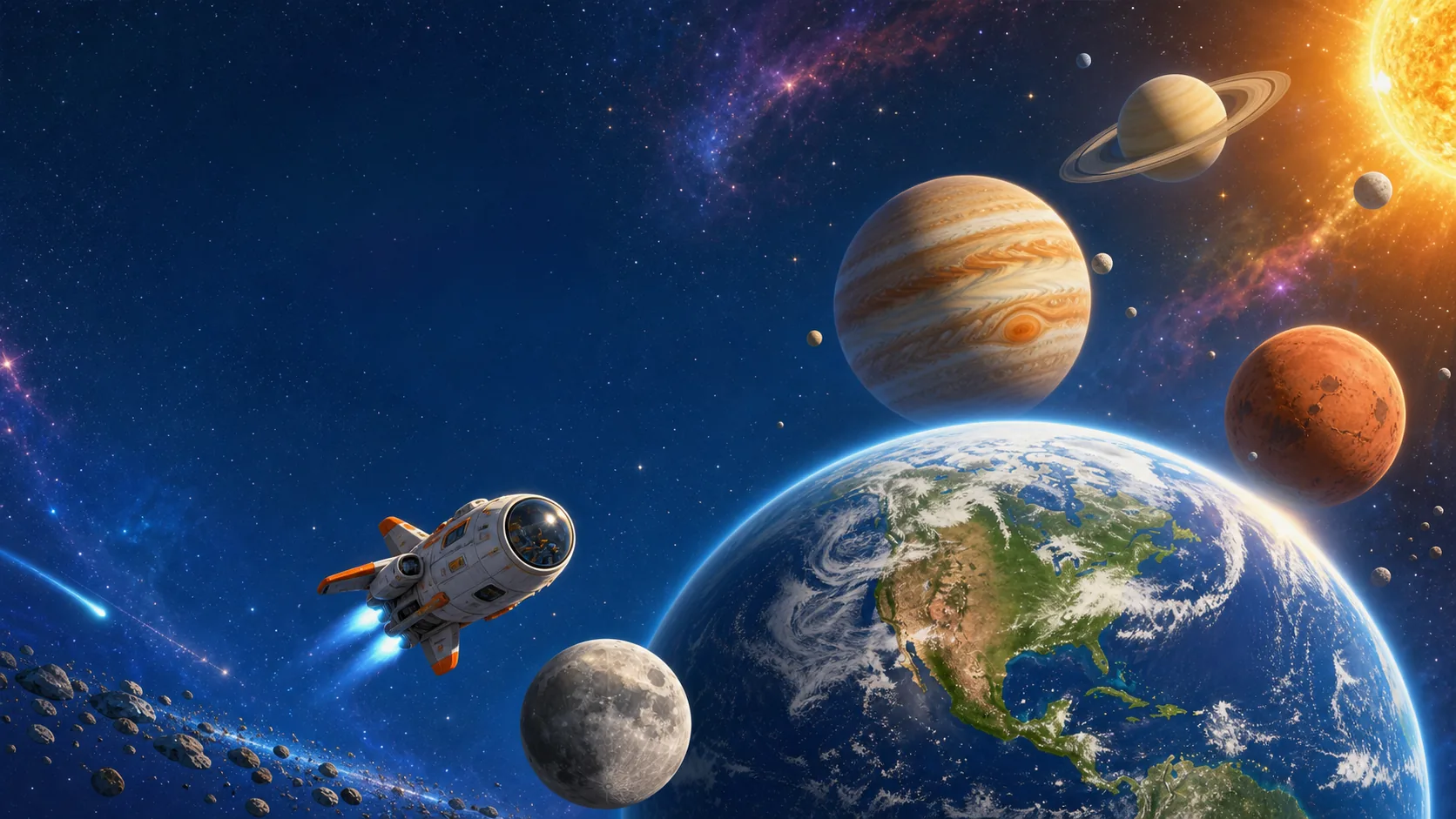
Grade 4 Space Explorer
Grade 4 Space Course
Explore the solar system through 3D orbit labs, web activities, embedded space videos, score games, skill checks, and a longer learning path.
Account Gate
Login saves progress privately across devices.
Lessons stay public. Saving progress, exams, Q&A, friends, chat, and collab tasks require login and verified email.
3D Orbit Lab
See real orbit motion from the main Exorbit explorer
Switch between log and linear distance, change the time rate, and focus on planets with reusable Exorbit 3D assets and Kepler-based orbit math.
- Real-time 3D solar-system scene with current UTC orbit positions
- Planet focus cards with orbit year, day length, moons, and planet type
- Friends-only game league with private score saving and challenges
Learning Path
Continue the course
Locked: Mission StarterLocked: Verified CadetLocked: First LaunchLocked: Orbit BuilderLocked: Course CompleterLocked: Question KeeperLocked: Exam AceLocked: Perfect OrbitLocked: 3-Day StreakLocked: 7-Day StreakLocked: First FriendLocked: Collab CaptainLocked: Orbit RacerLocked: Mission StrategistLocked: Moon Signal MasterLocked: Challenge ChampionLocked: Deep Space Pilot
Space Tools and Missions
Discover telescopes, satellites, probes, rockets, and rovers.
Continue Unit
Review and Space Scientist Skills
Use models, evidence, and communication like a scientist.
Continue Unit
Secure Account
Register or login
Accounts keep each learner's course records private. Verify email before saving scores, Q&A, chat, and collab work.
Email Check
Verify email
Enter the 6-digit code sent to your email to unlock private course records.
Course Materials
Lessons, activities, and checks
Each lesson includes a short read, an in-page web activity, embedded space videos or source prompts, vocabulary, and a quick check.
01
Unit 1: Our Solar System
Map the Sun, planets, moons, and smaller objects.
Solar System Map
The Sun is the center of our solar system.
Open LessonPlanet Order
Planets can be identified by their order from the Sun.
Open LessonSpace Distances
Space is much larger than classroom models can show.
Open Lesson
02
Unit 2: Earth, Sun, and Moon
Explain day, night, shadows, seasons, and Moon phases.
Day and Night
Earth spins once each day.
Open LessonMoon Phases
The Moon looks different because we see different sunlit parts.
Open LessonShadows and Seasons
Sunlight angle changes shadows and helps explain seasons.
Open Lesson
03
Unit 3: Planet Detectives
Compare planets by surface, atmosphere, size, and clues.
Rocky Planets
The inner planets have solid surfaces.
Open LessonGiant Planets
The outer planets are large, cold, and far from the Sun.
Open LessonPlanet Clues
Scientists use evidence to identify planets.
Open Lesson
04
Unit 4: Stars and Sky
Learn why stars shine and how sky patterns help observers.
Stars and the Sun
The Sun is the closest star to Earth.
Open LessonConstellations
Constellations are star patterns people named.
Open LessonSafe Sky Observing
Observe the sky safely and carefully.
Open Lesson
05
Unit 5: Space Tools and Missions
Discover telescopes, satellites, probes, rockets, and rovers.
Telescopes
Telescopes collect light to help us see faraway objects.
Open LessonSatellites and Probes
Spacecraft collect information from orbit and deep space.
Open LessonRovers and Rockets
Rockets launch missions, and rovers explore surfaces.
Open Lesson
06
Unit 6: Review and Space Scientist Skills
Use models, evidence, and communication like a scientist.
Science Models
Models help explain things that are too large, small, far, or slow to observe directly.
Open LessonSpace Report
A good science report uses evidence and clear labels.
Open LessonFinal Review
Review the whole course before the final exam.
Open Lesson
07
Unit 7: Space Data Lab
Read simple data, graphs, and evidence from space missions.
Moon Data Patterns
Moon observations form patterns that can be recorded and compared.
Open LessonOrbit Graph
Graphs help compare planet distances and orbit times.
Open LessonSpace Claim and Evidence
Science explanations connect a claim to evidence and reasoning.
Open Lesson
08
Unit 8: Earth From Space
Use satellites to study weather, water, land, and change.
Weather From Space
Weather satellites help people observe clouds, storms, and patterns.
Open LessonWater From Space
Space images help scientists track water on Earth.
Open LessonEarth Change From Space
Comparing images helps scientists notice change over time.
Open Lesson
09
Unit 9: Mission Engineering
Plan spacecraft with goals, constraints, tests, and teamwork.
Design a Rover
Rover parts are chosen to solve a mission problem.
Open LessonSatellite Design
Satellites need power, instruments, communication, and a stable orbit.
Open LessonMission Budget
A mission plan balances choices with limited resources.
Open Lesson
10
Unit 10: Deep Space and Careers
Explore galaxies, exoplanets, and space science careers.
Galaxy Map
A galaxy is a huge group of stars, gas, dust, and dark matter.
Open LessonExoplanet Hunt
Scientists find planets around other stars by looking for evidence.
Open LessonSpace Careers
Space work needs many skills, not only astronauts.
Open LessonGame Center
3D orbit arena and learning games
Play score-based science games, inspect planet models, and challenge accepted friends without exposing private learner records publicly.
Orbit Arena
Explore first, then play
Use the 3D explorer to compare rocky planets, giants, orbit years, and distance scale before you start a challenge.
3D space flight
Orbit Cruise Academy
Pilot a WebGL classroom cruiser between planets using real average orbit distances, mission clues, and score bonuses for efficient routes.
Orbit facts
Planet Sprint
Race through planet order, type, distance, moons, and year clues after exploring the 3D orbit lab.
Space tools
Mission Control Relay
Choose the right tool, mission plan, and evidence for satellites, probes, rockets, telescopes, and rovers.
Moon phases
Moon Signal
Read Moon phase clues quickly and score points before the timer ends.
Live Session
Start a game
Answer quickly, use evidence from the course, and save your best score when your account is verified.
Progress Record
Course progress and scores
Lesson completion, exam attempts, credits, badges, and streaks are saved after login and email verification.
0%
Unit Progress
Completion by unit
Score Record
Exam attempts
| Exam | Score | Correct | Date |
|---|
Student Profile
Learner profile
Profile details, progress, scores, credits, badges, Q&A, friends, chat, and tasks stay private to the logged-in learner.
Q&A Notebook
Ask, answer, and review
Use the question notebook for class discussion, homework review, and exam preparation.
Ask
New question
Common Questions
Review answers
Notebook
Saved questions
Exam Center
Practice quiz and final exam
Automatic scoring records every attempt in the progress page.
Friends and Collaboration
Study together safely
Students connect by exact friend code. Chat and collaborative tasks stay private to accepted friends and task members.
Friend Code
Add a friend
Your friend code: Login required
Requests
Friend requests
Friends
Accepted friends
Collab Tasks